Welcome to Namibia.

Winter is at 6am, Spring starts at 10am, Summer is at 2pm, and Autumn is around 5:30.

  • When packing for your holiday in Namibia, you need to prepare for all eventualities.
  • While it can be very hot in the summer, often reaching 40 degrees in the desert, it can also cool down considerably when it rains.
  • And although our winters are mild and sunny, we can experience both hot days and frost occasionally both within the same week!

Summer, Autumn, Winter and Spring
As we are in the South Hemisphere, December is in summer, and August is in the winter.
In Namibia, we don’t experience the typical three-month seasons.

  • Summer is long, running from October, November, December, January, February, and March (6 months).
  • This is followed by a short Autumn in April and May (2 months), although most leaves drop from deciduous trees only from late May.
  • Winter is relatively short, beginning in June, July and usually ending in August (3 months).
  • Then September constitutes a very brief Spring (1 month).

Inland versus Coast

  • Temperatures also vary across the country.
  • Inland areas and more northern parts of the country tend to be milder than the southern and western desert areas.

The Coast of Namibia has a climate of its own:

  • Dependent on the cold Benguela current coming up from Antarctica, the Namibian coast is persistently cool, often misty, or cloudy.
  • We generally get 4 seasons in one day. A typical day would be foggy in the morning, sunny at midday, windy in the afternoon and cold at night!
  • The temperature can drop to 7-8C in the winter, and it is unusual if it reaches 30C in summer.
  • On the coast, the best weather is generally between January and April.
  • Surprisingly, in the middle of the winter, when we have East wind, which comes from the desert, the temperature can reach 25C-30C at times!!

Rainfall in Namibia

  • Rainfall in Namibia is normally limited to the summer months of October to March, sometimes extending into April and early May.
  • The heaviest rains normally fall from January to March.
  • Rainfall also varies across the country from south-west (lowest rainfall) to north-east (highest rainfall).
  • Most of the rain falls happens in the evening and at night.
  • You may see fewer animals in the rainy season as they no longer need to go to the waterholes and tend to go further .

So, by now you are probably very confused about the climate in Namibia and wonder when the best time is to come on holiday.

Anytime of the year is good, and like anywhere else in the world, the weather is quite unpredictable from one year to the next and even from one day to the next.

I would say that if you can, avoid the month of August, as it generally gets very busy and if this is the only convenient time for you, try to book 8 months to a 1 year in advance to secure your first choice of care hire, lodges, and activities.

One day in Walvis Bay.

Recently we were invited for a full day of adventure (09:30 to 18:00) with the tour company Mola Mola, in Walvis Bay.

At 09:30, we boarded a boat at Walvis Bay Waterfront to go around the Bay where pelicans and seals happily jump on-board, to the joy and surprise of the tourists. It is a safe, unusual, and a fun encounter.


As we navigate along around the Bay of Walvis Bay, the skipper gives local knowledge about the local industry, the oyster farm, the fishing industry, some facts about birds, fish, and if you’re lucky, you may see some dolphins swimming at a short distance from the boat. Free drinks are served on-board.

Then, about lunch time, we disembark onto Pelican Point beach for a fantastic braai. (barbecue). On the menu, there was crayfish, meat, local oysters, and delicious salads. Champagne and other drinks are also included.

At our own pace, a guide awaits us in a 4×4 vehicle to take us to Sandwich Harbour, which is a protected site, where the high dunes meet the sea and merge around a beautiful lagoon which is generally a meeting point for birds.

You normally reach Sandwich Harbour through the dunes or drive on the beach, depending on the tide.

On the route, our guide regularly stops the car for us to take pictures or to discover little animals living in the dunes, like geckos, Tok Tokkies, etc.

Mola Mola is more expensive than other local operators, but it is top quality and service.

If you ever come to Walvis Bay, it is really a very enjoyable trip to do for adults and children alike.


Kind regards


Murielle

So let us talk today about Kolmanskop, the famous diamond mine, 10km away from Luderitz, which is located South West of the country.

The great diamond rush was mostly between 1908 and 1914. In 1912, Kolmanskop was producing a million carats a year, or 11.7% of the world total diamond production. The diamonds were small but of high quality.

The Germans shipped most of the equipment/material from Germany, in particular to build houses in Kolmanskop. There was a butcher, a baker, a post office, an ice factory, they had a little train that would deliver the ice and lemonade to the houses every morning.

Fresh water was brought by rail. They also had electricity, a police station (camels were used frequently for their patrols), one of the first X-Ray machines (for medicinal purposes and also to check that they did not swallow diamonds), a skittle alley.

European opera groups even came to perform. There were avant-garde for the time, and it must have been quite an eccentric life in the middle of the desert. There were about 300 Germans, 40 children and they employed 800 local Namibians who were living further away.

To have a feel of what life must have been back then, Marianne Coleman, who was a little girl at the time, and the daughter of a foreman at Kolmanskop, recalled:

“One of my early childhood memories is of labourers being sent out with empty jam jars, a small spade and a hand broom, returning later in the day with jars filled with diamonds.

We had a post office there, and that was our link to the outside world. Post was delivered late on Friday afternoons.

We did not have refrigerators but cooler chests. I remember the ice man doing his rounds delivering ice blocks every day.

The butcher was Mr. Zirkler, and the baker was Mr. Brechlin. Every morning on his way to work, father would drop off his daily order at the store, bakery, or butcher. Fresh bread or rolls, meat and other groceries were delivered before noon. Mr. Zirkler made the best smoked Vienna sausages you could imagine. In the store one could buy home made fudge and toffees. Behind the store was a playground for the children. There was a large workshop, a huge depot, a carpentry shop, offices and stables.

We had a painter from Germany who painted the insides of the houses with fabulous patterns and designs. We had a seawater swimming pool. The water was pumped all the way from Elizabeth Bay. The overflow water was used on the plant and for cleaning purposes. There were bathing huts around the pool, birthday parties were held there, and on Sundays, weather permitting, the band played and we all had a jolly time.

There was a primary school with a playground complete with swings and merry-go-round. At the top of a sand-dune hill was a reservoir which served a dual purpose. It provided the mining plant with water for the washing and treatment operations and was also used as a swimming pool by the residents of Kolmanskop. Sea water was pumped through a long pipeline from Elisabethbucht 28 kilometres away.

In 1910 they built a central power station in Luderitz to supply electricity to the diamond fields.

Housing, electricity and fuel were provided free by the company, which also maintained a well-built hospital. The hospital had one of the finest X-ray plants in Southern Africa.

The hospital also had its own wine cellar. The wine was moreover used medicinally. One of the two resident doctors Dr. Kraenzle, believed that patients recovered more speedily if they received some stimulation in the form of a little wine or Champagne.

In 1927 a magnificent new recreation centre was built where many functions and forms of entertainment were held. It had perfect acoustics, designed by an expert from Germany. There was also a gymnasium and film showings, a bowling alley, a casino and a theatre. Theatre groups, musicians and artists came regularly.

Working hours on the mine was nine hours every day for six days a week, with only special days like Easter or Christmas, New Year, etc, being given off. In the early days church services were held in the school building.

Wages were good and virtually everything was free, including company houses, milk deliveries and other fringe benefits.

It was difficult to keep a pet, but we had an ostrich which pulled a little sleigh over the sand. An ostrich is not a docile beast and I remember the terror from housewives as we careered along. The ostrich stopping every now and again to pinch and eat anything that it could find. Nevertheless, the ostrich and sleigh was used at Christmas time to bring father Christmas and some presents…”

Unfortunately, I have not found a picture of Marianne or information about her life afterwards.

Today Kolmanskop is a little treasure for photographers and history lovers.

Intensive mining depleted the area by the 1930s when new diamond fields were found further South. People left in droves, abandoning homes and possessions. By 1956 Kolmanskop was completely abandoned.

Today there are still some diamond mines but most of the production of diamonds is from marine extraction.

Namdeb Diamond Corporation (Pty) Limited is owned in equal shares by the Government of the Republic of Namibia and De Beers.

De Beers conduct marine-based diamond recovery around 120 to 140m below sea level in the Atlantic Ocean off the Namibian coast. They operate a fleet of 6 vessels, capable of exploring for and retrieving diamond-bearing materials from the seabed and processing them to a diamond-rich concentrate.

On De Beers website, it says that Namibia has the richest known marine diamond deposits in the world, estimated at more than 80 million carats.

If you fancy coming to Namibia and would like to bring some diamonds back home, only cut diamonds are legal.

Kind regards

Murielle@alacartetravels.com

So, continuing our family trip, we will explore tonight Luderitz, with a little bit of history.
Luderitz is a small coastal town in the Southwest of Namibia.
It is the second commercial port after Walvis Bay.

Luderitz is notorious for its wind blowing more than 300 days in a year.

The town of Luderitz was previously named Angra Pequena (Narrow Bay), when the Portuguese Navigator Bartolomeu Dias step foot here in 1487 and erected a stone cross, on Luderitz Southern Peninsula.

To understand Luderitz better, let me give you some historical context:
German Southwest Africa was a colony of the German Empire, under Bismark from 1884 until 1915, although Germany did not officially recognize its loss of this territory until 1919, with the Treaty of Versailles.

You will see on the map dated 1915, that Namibia was invaded by the Germans, and Walvis Bay, was part of the British Empire.
In 1883, Adolf Luderitz, who was one of Germany’s first prominent colonialists, signed an agreement with Chief Joseph Frederick of Bethanie, in what is now Southern Namibia. The treaty gives the German businesseman rights to the area around the strategic harbour of Angra Pequena, which he renamed Luderitz.

In those years, Zacharias Lewala, who was a worker in a diamond mine in Kimberley, South Africa gained experience in the recognition of rough diamonds

Later, he worked in Luderitz at the maintenance of the railway under his German Superior August Stauch.

In 1908, while he was working near Kolmanskop, which is 10km from Luderitz, he discovered several stones which he suspected to be diamonds.
Zacharias Lewala dutifully reported it to his Boss.
Mr Stauch and his friend Nissen, as they realized they were diamonds, initially kept the knowledge secret, and only announced it after securing about 35 hectares around Kolmanskop to continue diamond searching.

Afterwards, realizing that the area was full of diamonds, the German government then prohibited entry to almost the entire extent of Namibia’s Southern Coast, declaring it the Speergebiet, meaning forbidden zone, where no one can enter without a permit.

It was the start of the diamond rush, the town of Luderitz observed an economic boom between 1908 and 1914. Luderitz was at the time known, as Africa’s richest town.

For the anecdote, Zacharias Lewala apparently received nothing for his find, not even some form of gratitude; while many, like August Stauch made a fortune, which he later lost through bad investments and the Great Depression.

The 30 years of German colonialism made a big imprint in the country, in many ways. In Luderitz, it can be seen today in the beautiful architecture of some houses.

In the next blog, we will be visiting the Diamond mind of Kolmanskop and the glittering lifestyle they had at the time.

Kind regards

Murielle@alacartetravels.com

Dear Readers

Let me talk to you about our recent experience with the San tribe in Namibia. The San people are also called the Bushmen. We visited their settlement close to the Botswana border, in the Nyae Nyae conservancy https://bit.ly/3dUgTH0, near the Khaudum National Park. This is a very remote and isolated region in Namibia. The Nyae Nyae Conservancy is the home of the San people, who are our oldest human ancestors and the direct descendants of the original Homo Sapiens https://bit.ly/30zgNRr  They are possibly the world’s most ancient race and are said to carry the oldest human Y chromosome. https://bit.ly/3hlKyeG.

With a San national population of around 30,000, they constitute less than 2% of the Namibian population and have the lowest income per capita in the country.

So, with Anton, my Life Partner, we ventured to the wild. With my beloved car, the tent on the top, the fridge in the back, and plenty of petrol, food, and water.

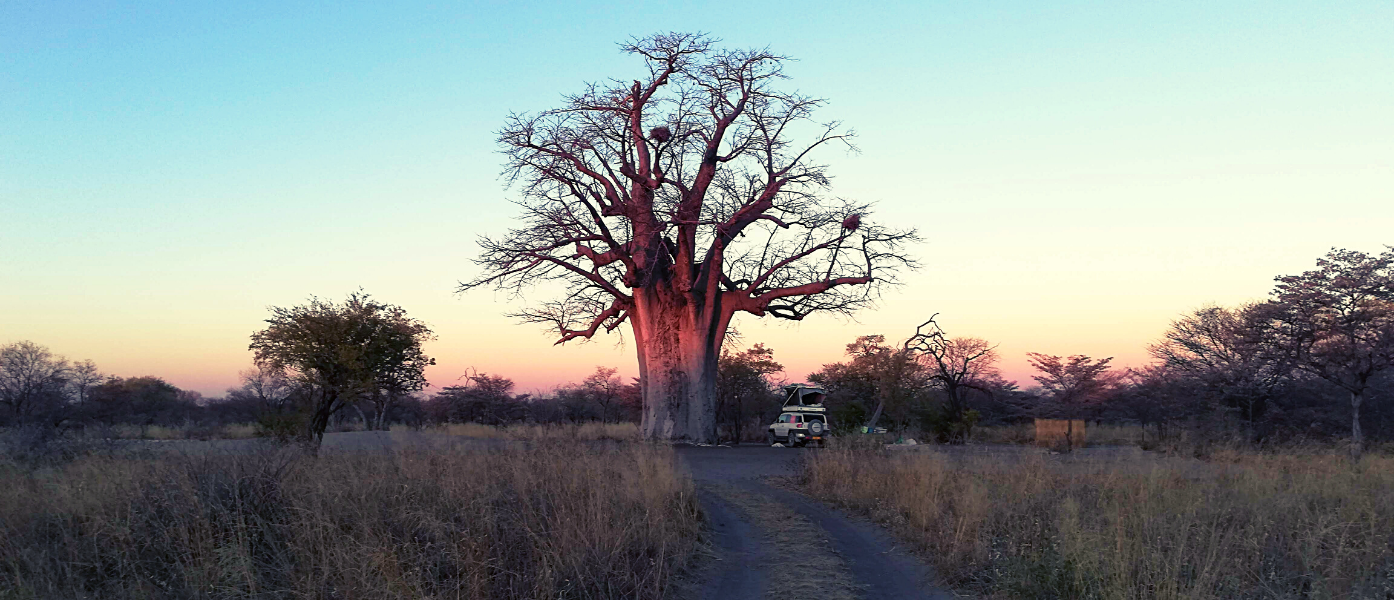
We set camp at a designated spot near a beautiful baobab tree, very close to the village. There was no water, no electricity and the San people gave us some wood for a fire.

Back to the simplicity of life and the stillness of nature, which started percolating our skin.  Yes, it takes a little while to adjust to the silence of nature.


The following day, Small Boy who is also a San, was our guide and translator.

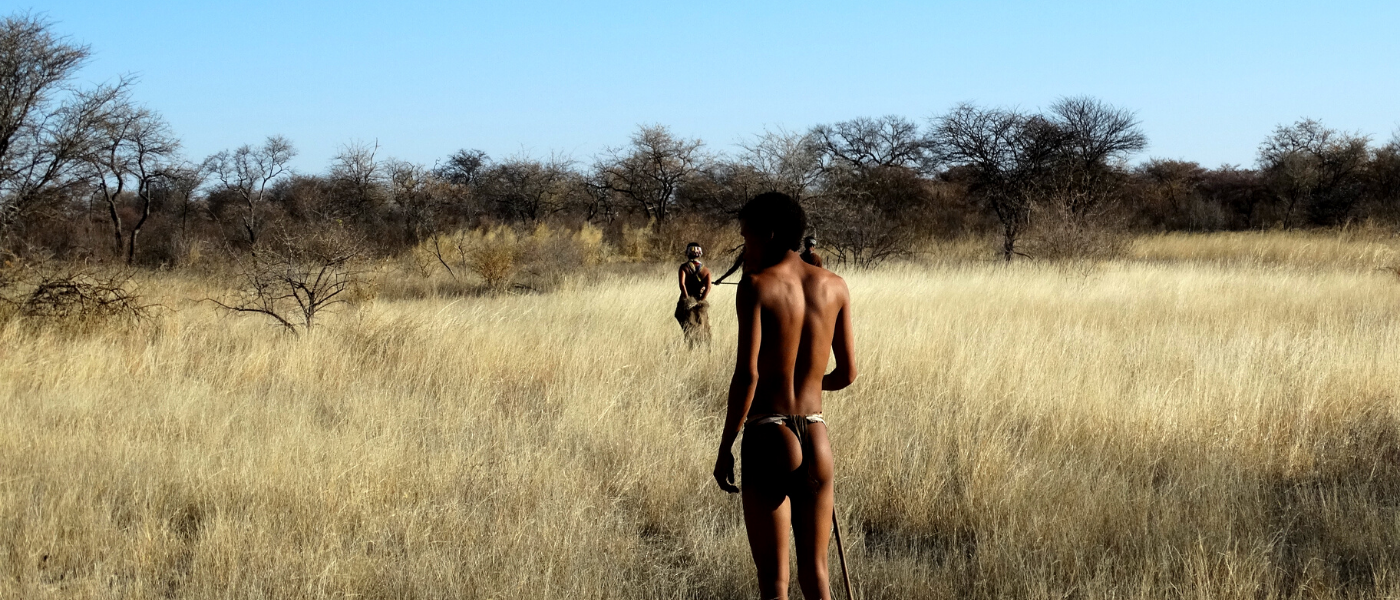
He explained that there are several San sub-tribes and languages and the one visited is Ju l’hoansi. The San people in Namibia speak with amusing clicks, wear hardly any clothes, and in general, are very thin and short in stature. Also, they are said to be the best hunters and gatherers in the world. The San still use this ancient knowledge.

Accompanied by Small boy, we booked a full day immersion and went hunting with about 15 San men and women. Near the villages, they are allowed to hunt freely only with bows and arrows. There are many animals including springboks, kudus, blue wildebeest https://bit.ly/37i4XMK  hartebeest https://bit.ly/3dQ7m3H  porcupines https://bit.ly/3dQ7m3H, etc. They showed us how to start a fire with some twigs. I tried and failed a few times before managing with some help!!😊

They showed us how to find plants containing water underground; how to make traps for animals; which edible berries to collect. They also explained how they use some plants for medicinal purposes.

At the end of our day, in a bird’s trap, they caught a red created korhaan https://bit.ly/37jgSdo. They cooked it for us for dinner with pap https://bit.ly/37jgSdo  It was at night, we did not quite know what we were eating, and I am sorry to say that the bird was tough! 😊.

Then, around a fire at night they sang, told each other fun stories about hunting and the greatness of their ancestors. They danced, went into a trance, the Medicine Man gave healing to each person including us, which was a big surprise.

From this day of activity, what touched me most and, is that they were quite shy with us. Perhaps they seldom see visitors or we look a bit like aliens to them. I am not sure.

However, when observing them mingle together, it was so nice to see that they have so much respect and kindness for each other. No one is better than the other, everybody seems to have their own place in the community. They are also joyful and playful in a gentle and quiet way. They blend with nature, follow the rhythm of the days, in a soft, quiet, and natural way.

Perhaps I am idealizing. I don’t know. The San tribe in Namibia is materially very poor and seems to have limited access to the abundance of water and food. Some of the elderly seem in poor health. They are scared of going to modern doctors or hospitals, which are against their belief systems. There are also problems with alcoholism in some of the San settlements in the country.

The San people in Namibia are the most marginalized tribe and there is little integration with the rest of the population. Perhaps it is how they want it to be. To have the freedom to live happily in their bubble of gentleness, togetherness, and simplicity. To care for each other without the interference of technology, complexity, and materialism.

Perhaps it is gradually changing with the influx of tourists and the new generations may be attracted to the material world.

However, it is quite amazing and remarkable that this particular San settlement can survive in a different era, isolated and mostly oblivious to the modern world around them. How long will it last like this? I don’t know but I wish they can retain their identity and authenticity for a long time to come.

What we remember most from our experience, is a genuine feeling of humility, simplicity, harmonious connection with nature, and their joy and respect for each other. The San people touched our hearts.

Warm regards

Murielle

ps. Please do not miss to read my last blog on https://alacartetravels.com/namibia-with-covid-19-and-what-i-enjoy/ and feel free to visit our website  http://www.alacartetravels.com.  Dankie😊